
Gippsland BESS
600MW Battery Project

Gippsland Community drop in sessions
Come along to share your input and meet the team at the upcoming Community Drop-In Session.
No RSVP required, light refreshments provided.
Key details
- Location: Hazelwood North Public Hall (117 Church Road, Hazelwood North)
- Date: Tuesday 17th February 2026
- Time: 2:30pm – 6:00pm
About Gippsland BESS
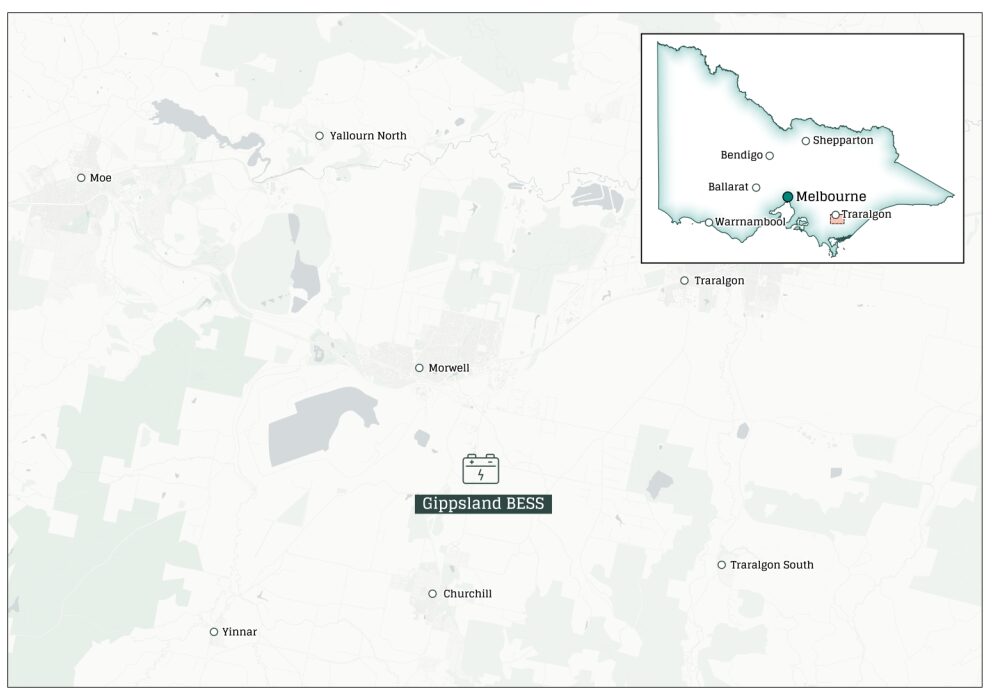
The Gippsland BESS project involves the development, construction and operation of a 600MW BESS, near the Hazelwood Terminal station in Latrobe Valley of Victoria. This project will help provide energy security for the Gippsland region and assist with the enhanced integration of renewable energy projects already in the area.
For more information or opportunities to work with us on this project, please contact us at infoaus@europeanenergy.com
Project Timeline

FAQ
Why build a BESS in Gippsland?
The Latrobe Valley has played a longstanding role in Victoria’s electricity network due to its coal fired power stations and extensive transmission infrastructure. As Victoria transitions away from coal-fired generation and increases its reliance on renewable energy, additional battery storage is required to maintain grid stability, reliability and energy security.
Hazelwood North and Churchill fall within one of the Victorian Government’s proposed renewable energy zones. This means that the Gippsland region has been identified as having abundant renewable energy resources and existing infrastructure making it ideal for renewable energy projects.
Each battery storage system performs a specific role within the electricity network. While there may be several battery projects proposed or approved in the region, they do not operate as a single facility. Instead, each battery connects at a particular point on the grid and provides services such as storing excess renewable energy, responding rapidly to changes in electricity demand, and helping to prevent outages.
Having multiple batteries in the same area allows the grid to:
- respond more effectively to fluctuations in supply and demand,
- support more renewable energy projects across Victoria, and
- reduce reliance on fossil fuel generation during peak demand periods.
Importantly, all battery projects are subject to detailed technical and regulatory assessments to ensure the electricity network can safely accommodate them. Projects are only approved where they can operate without compromising grid performance or reliability.
What happens to a BESS in the event of a bushfire?
BESS’ are designed to operate safely in bushfire-prone environments and are required to comply with strict Australian and Victorian safety standards. The facility will be designed with appropriate setbacks, vegetation management zones and fire-resistant materials to reduce bushfire risk.
In the event of a bushfire in the surrounding area, the battery system can be safely shut down remotely or automatically, depending on conditions. The site layout is designed to limit the spread of fire, and individual battery units are separated to prevent fire transfer between units.
A Bushfire Management Plan will be prepared as part of the approvals process, outlining prevention, response and recovery measures. This includes coordination with emergency services and compliance with guidance from Fire Rescue Victoria and other relevant authorities to ensure the safety of the site and surrounding community.
Can multiple BESS connecting into the same point, overload the grid? How will this be prevented?
BESS projects cannot connect to the electricity grid unless it has been demonstrated that the network can safely accommodate them.
Each battery storage project undergoes rigorous technical assessment by the network service provider and the Australian Energy Market Operator (AEMO). These assessments consider the cumulative impact of all existing, approved and proposed connections in the area.
Where multiple batteries are connecting to the same or nearby grid infrastructure, operating limits and control systems are put in place to ensure the combined output does not exceed what the network can safely manage. This includes automated controls that regulate when and how much power a battery can charge or discharge.
If network constraints exist, projects may be required to curtail output, upgrade infrastructure, or modify operating arrangements. Batteries are only approved where they can operate without compromising grid stability, reliability or safety.
Will the impact of multiple BESS projects be assessed together?
Yes. Planning and technical assessments consider cumulative impacts, including noise, traffic, visual amenity and grid performance. Regulators assess how each project interacts with others in the area to ensure acceptable outcomes for the community and the electricity network.
Will having several BESS nearby increase noise levels?
Each battery project must meet strict noise limits at nearby residences, both on its own and in combination with other developments. Noise modelling considers cumulative impact, and mitigation measures are required where needed to ensure compliance with Victorian noise standards.
Does having several BESS together increase fire risk?
Each battery facility is designed to operate independently with its own safety, fire detection and suppression systems. Separation distances, site layout and emergency response planning are designed to prevent incidents at one site from affecting others.